

What is GEO?
Generative Engine Optimization (GEO) is the practice of optimizing digital content to increase visibility and citability in AI-generated responses from platforms like ChatGPT, Perplexity, Google AI Overviews, Claude, and Gemini. GEO focuses on making content easily discoverable, understandable, and citable by large language models (LLMs) that generate answers instead of traditional search result lists. Unlike traditional SEO, which optimizes for ranking in search engine results pages (SERPs), GEO optimizes for being selected, cited, and presented as authoritative sources within AI-generated narratives. The GEO market was valued at $850 million in 2025 and is projected to reach $7.3 billion by 2031. At digitalfarm, we’ve been implementing GEO strategies since early 2025, helping UAE businesses adapt to this shift in search behaviour and content discovery.
Why GEO Matters Now
AI search traffic has grown 527% year-over-year, according to SparkToro data from late 2025. This growth signals a fundamental shift in user behaviour that businesses can’t ignore.
Google AI Overviews now reach 1.5 billion users monthly, appearing for approximately 15-20% of all Google searches. Traditional organic results are increasingly displaced by AI-generated summaries.
ChatGPT has surpassed 900 million weekly active users as of early 2026, making ChatGPT search a major discovery channel. Users are prompting AI engines directly instead of using traditional search boxes.
Traffic from AI sources converts at 4.4 times the rate of traditional organic search, according to conversion data tracked across multiple industries. AI-referred visitors arrive with clearer intent and higher engagement.
Gartner predicts traditional search engine traffic will drop 50% by 2028 as generative AI becomes the primary interface for information discovery. Businesses that ignore GEO risk lose half their discoverability.
Only 23% of marketers are currently investing in GEO, creating a significant first-mover advantage for organizations that optimize now. The competitive arena for AI visibility remains wide open.
GEO vs SEO: Key Differences
Understanding how Generative Engine Optimization differs from traditional Search Engine Optimization is needed for adapting strategies.
| Aspect | Traditional SEO | Generative Engine Optimization (GEO) |
|---|---|---|
| Primary Goal | Rank high in search results pages (SERPs) | Get cited in AI-generated answers |
| Success Metric | Click-through rate, rankings, impressions | Citation rate, source attribution, context inclusion |
| Content Structure | Keyword-focused, heading hierarchy | Answer-first passages, self-contained explanations |
| Optimization Unit | Full pages, articles | 134–167 word citable passages |
| Link Strategy | Backlinks for authority | Brand mentions, contextual citations |
| User Journey | Click, land on page, browse | Direct answer, optional source click |
| Traffic Pattern | High volume, lower intent | Lower volume, extremely high intent |
| Content Length | Often 2000+ words for competitiveness | Concise passages, statistical density |
| Technical Signals | Meta tags, robots.txt, sitemaps | llms.txt, schema markup, structured data |
| Authority Signals | Domain authority, PageRank | Citability score, statistical credibility |
| Measurement | Google Search Console, rankings | AI engine monitoring, citation tracking |
| Competitive Analysis | SERP analysis, keyword gaps | Citation frequency, answer presence analysis |
The table shows how GEO requires a fundamentally different approach to content creation and optimization.
How AI Search Engines Work
ChatGPT Search uses a combination of web crawling, real-time retrieval, and language model synthesis. ChatGPT identifies relevant sources, extracts key information, and generates coherent answers with inline citations.
Perplexity AI focuses on transparency and source attribution. Perplexity presents answers with numbered citations, allowing users to verify claims and explore original sources directly.
Google AI Overviews (formerly SGE) appears at the top of traditional search results. Google AI Overviews synthesises information from multiple sources, presenting a comprehensive answer before traditional organic listings.
Claude and Gemini power various search and assistant interfaces. These models prioritise factual accuracy and will explicitly state when information is uncertain or unavailable.
The retrieval process typically involves semantic search, where AI engines identify content based on meaning rather than exact keyword matches. Content structure, statistical density, and clear attribution increase retrieval likelihood, principles that sit at the core of AI in SEO .
Source selection criteria include domain authority, content freshness, citation-worthy structure, statistical support, and clarity of explanation. AI engines favor authoritative sources that present information in digestible, verifiable formats.
The GEO Optimization Framework
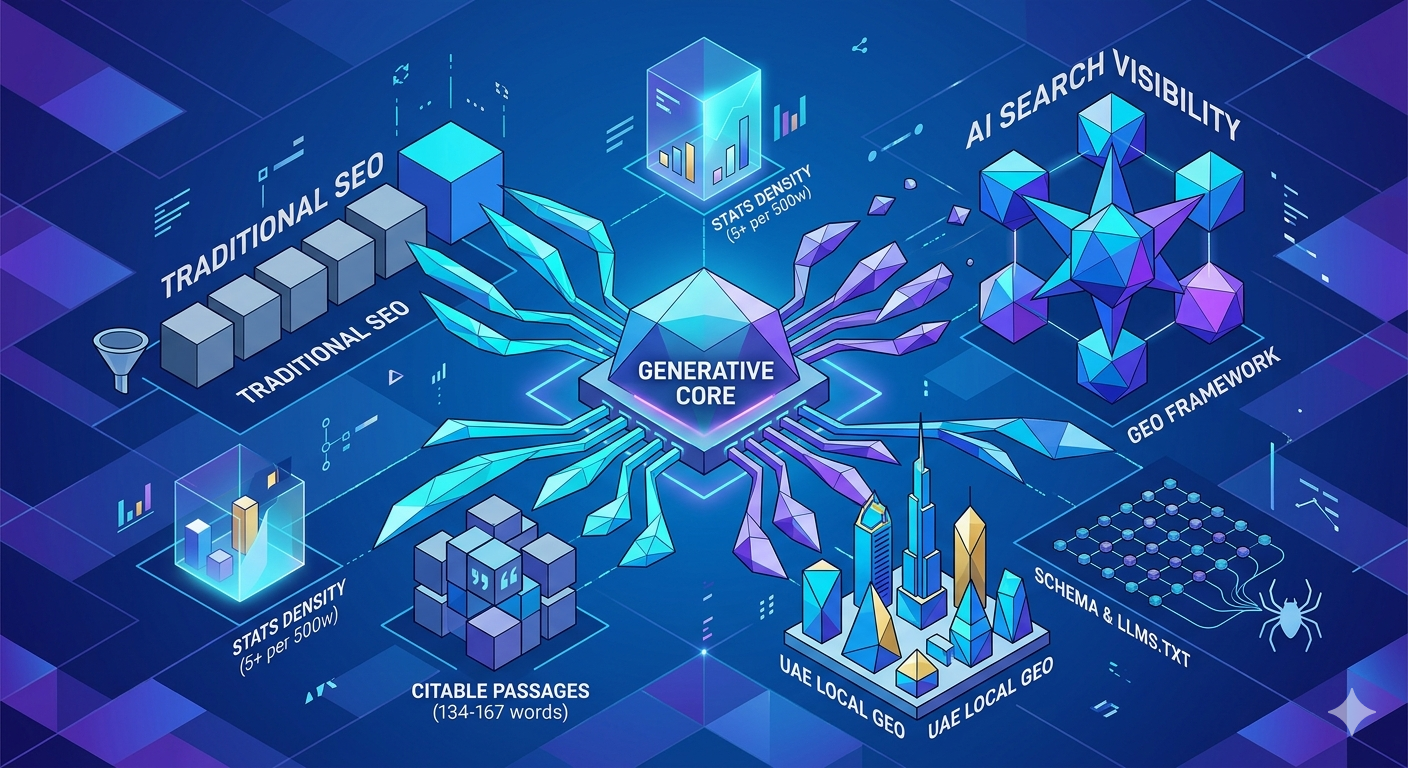
The answer-first content structure places the complete answer in the opening 134-167 words. This self-contained introduction allows AI engines to extract and cite the core information without requiring additional context.
Statistical density means including 5+ specific statistics, percentages, or data points per 500 words. AI engines prioritise content with quantifiable claims over vague assertions.
Explicit subject naming requires naming the subject in every paragraph, avoiding pronouns without clear antecedents. This clarity helps AI engines accurately attribute information and avoid confusion.
Short, focused paragraphs of 2-4 sentences maximise citability. AI engines can extract precise passages without including irrelevant surrounding content.
Comparison tables present information in structured formats that AI engines can parse and reference easily. Tables with 12+ comparison points provide comprehensive reference material.
An authoritative tone establishes credibility through specific examples, industry data, and clear methodology. Vague or promotional language reduces the likelihood of citations.
Brand mentions over backlinks matter more for GEO. Research from Ahrefs indicates that brand mentions correlate 3x more strongly with AI citations than with traditional backlink metrics.
Citability: The Core Metric
Citability measures how likely AI engines are to select and attribute your content when generating answers. Citability depends on passage structure, statistical support, clarity, and signals of authority.
The 134-167 word passage represents the optimal length for AI citations, according to Princeton University GEO research. This length provides complete context while remaining concise enough for inline inclusion.
Princeton research demonstrated 30-115% higher visibility for content optimized using GEO principles. The study analysed citation patterns across major AI platforms and identified structural factors that increased selection rates.
Self-contained explanations that define terms, provide context, and include supporting data within a single passage significantly outperform those that require external context. AI engines favour completeness.
Statistical specificity transforms generic claims into citable facts. “GEO is growing rapidly” has near-zero citability, while “the GEO market grew from $850M to a projected $7.3B by 2031” provides concrete, verifiable information.
Source attribution within your own content increases trust. Citing specific studies, industry reports, or data sources makes your content more credible to both AI engines and readers.
Schema markup provides machine-readable context about your content type, author credentials, publication date, and factual claims. Structured data significantly improves AI comprehension and citation likelihood.
Technical GEO Implementation
llms.txt is an emerging standard for communicating with AI crawlers. The llms.txt file sits in your domain root and provides crawling permissions, content priorities, and optimization hints specifically for language models.
Schema markup should include Article, FAQPage, HowTo, and Organisation schemas. These structured data types help AI engines understand content context, authority, and relationships.
The robots.txt configuration must allow AI crawlers, including GPTBot, Google-Extended, PerplexityBot, and ClaudeBot. Blocking these crawlers eliminates GEO visibility entirely.
Content freshness indicators like “Last updated” timestamps signal currency to AI engines. Recent updates increase the likelihood of citation for time-sensitive queries.
Structured data for statistics using Dataset and ClaimReview schemas helps AI engines identify and verify factual claims. This verification builds trust and citation preference.
Clear authorship attribution through Author and Person schemas establishes expertise and authority. AI engines favour content from identified subject matter experts.
Internal linking structure helps AI crawlers understand content relationships and topic authority. A well-structured site demonstrates comprehensive coverage of subjects.
GEO for UAE Businesses
UAE market search behaviour is shifting rapidly toward AI-powered discovery. Local businesses risk losing visibility as Arabic and English queries increasingly happen through ChatGPT, Google AI, and regional AI platforms, making a strong local SEO foundation increasingly important.
Bilingual GEO optimization is critical in the UAE markets. Content must be optimized for both English and Arabic AI queries, with culturally appropriate examples and statistics.
Regional specificity increases the likelihood of citations for local queries. Including UAE-specific data, examples, and context positions content as authoritative for regional questions.
Local business schema with detailed location, service area, and Arabic name variants helps AI engines connect businesses to geographically specific queries.
Government and institutional citations from UAE sources carry particular weight. References to the Dubai Statistics Center, Abu Dhabi government data, or regional industry reports strengthen authority.
E-commerce and service businesses see the highest impact from GEO in the UAE markets. AI engines increasingly answer commercial queries with specific business recommendations based on structured data and reviews.
How digitalfarm Approaches GEO
Our agency, digitalfarm, has been implementing GEO strategies since early 2025, making us among the first AI SEO agencies in the UAE to offer dedicated Generative Engine Optimization services.
Our GEO work combines content restructuring, technical optimization, and continuous monitoring. We audit existing content for citability, rewrite passages to meet optimal length and structure, and implement technical signals that AI engines prioritise.
We track citations across ChatGPT, Perplexity, Google AI Overviews, and Claude to measure real-world GEO performance. Citation monitoring reveals which content formats and topics drive AI visibility.
Statistical research and data sourcing form the foundation of our content approach. Every piece includes verifiable statistics, industry data, and specific examples that AI engines can confidently cite.
We maintain active testing programmes to identify emerging GEO factors and optimize client content based on real performance data rather than speculation.
Frequently Asked Questions
What is the difference between GEO and SEO?
GEO optimizes content to be cited in AI-generated answers, while SEO optimizes for ranking in traditional search results pages. GEO focuses on citability, statistical density, and passage structure, whereas SEO emphasises keywords, backlinks, and page authority.
How do I know if my content is being cited by AI engines?
Monitor AI platforms directly by searching relevant queries in ChatGPT, Perplexity, and Google AI Overviews. Track whether your brand or content appears in generated answers. Several emerging tools also track GEO visibility, though the market is still developing.
What makes content citable for AI engines?
Citable content includes specific statistics, self-contained explanations in 134-167 word passages, explicit subject naming, clear structure, authoritative tone, and proper source attribution. Statistical density and factual specificity significantly increase citation likelihood.
Do backlinks still matter for GEO?
Backlinks matter less for GEO than traditional SEO. Brand mentions and contextual citations correlate 3x stronger with AI visibility according to Ahrefs research. However, backlinks still contribute to overall domain authority that AI engines consider.
How long does GEO optimization take to show results?
GEO results can appear within days as AI engines recrawl and reprocess content. Unlike traditional SEO, which can take months for ranking changes, GEO visibility often updates rapidly once content meets citability criteria.
Should I optimize existing content or create new content for GEO?
Both approaches work. Audit existing high-traffic content and restructure it for citability first, as this uses existing authority. Then create new content following GEO principles from the start for comprehensive coverage.
What is llms.txt, and do I need it?
llms.txt is an emerging standard file that communicates with AI crawlers, similar to robots.txt for traditional search engines. While not yet universal, implementing LLMs.txt demonstrates GEO readiness and may provide optimization advantages as the standard evolves.
How much should businesses invest in GEO versus traditional SEO?
Most businesses should maintain both SEO and GEO strategies. A balanced approach might allocate 30-40% of optimization budgets to GEO in 2026, increasing as AI search traffic continues growing. The exact split depends on your audience’s search behaviour patterns.
What industries benefit most from GEO?
Industries where users seek direct answers benefit most: healthcare, finance, legal services, education, B2B software, and professional services. E-commerce also benefits significantly as AI engines increasingly recommend specific products and services.
Can GEO help local businesses in the UAE?
Yes. GEO helps local UAE businesses appear when users ask AI engines for recommendations, comparisons, or information about regional services. Bilingual optimization and regional schema markup significantly improve local GEO visibility.
Conclusion
Generative Engine Optimization represents the next evolution of search visibility. As AI-powered answer engines replace traditional search for billions of users, businesses must adapt content strategies to remain discoverable.
The shift is happening now, not in some distant future. With Google AI Overviews reaching 1.5 billion users monthly, ChatGPT surpassing 900 million weekly users, and AI traffic growing 527% year-over-year, the transformation of search is already underway.
First-mover advantage exists today. Only 23% of marketers are investing in GEO, creating a significant opportunity for organisations that optimize now. The competitive arena will become far more challenging as adoption increases.
GEO requires a different mindset than SEO. Success comes from citability, not rankings. Statistical density, passage structure, and clear explanations matter more than keyword density or backlink counts.
digitalfarm helps UAE businesses navigate this transition, combining technical GEO implementation with content optimization and performance monitoring. The question isn’t whether to invest in GEO, but how quickly to begin.
The future of search visibility belongs to content that AI engines trust, understand, and cite. Start optimizing today.
Written By

Ben Seward
Head of Digital
Ben Seward is the Head of Digital at digitalfarm, bringing 10+ years of experience in technical SEO, GEO (Generative Engine Optimisation), web strategy, and digital transformation across the GCC region. He has led digital growth initiatives for government entities, large enterprises, and high-growth brands, delivering measurable improvements in search visibility, user experience, and online performance.
With a strong background in both SEO and web development, Ben specialises in aligning technical infrastructure with search strategy—ensuring websites are not only discoverable but built for long-term scalability and performance. His expertise includes complex site architectures, AI-driven search trends, and enterprise-level SEO frameworks.
Ben actively drives innovation within digitalfarm, helping clients adapt to evolving search ecosystems including AI-powered search, structured data implementation, and modern content discovery strategies.